🛰 Software Engineering for HPC · 2026 · Politecnico di Milano
AstraLog-HPC
Spacecraft Telemetry Anomaly-Detection Pipeline
Full Track · single-student · lecture-by-lecture validated
v1.0.0 · 2026-06-09
Full Track
C++17 · CMake · CTest
Apptainer / SLURM
AstraLog-HPC · SE4HPC 2026
Introduction
Project & Author
- Seyed Vahid Ghayoomie · Student ID 11142478
- Course: Software Engineering for High-Performance Computing
Politecnico di Milano · 2026 - Instructors: Prof. Elisabetta Di Nitto · Dr. Simone Reale
- Track: Full Track (single-student) · Mission close 2026-06-14
AstraLog-HPC → a C++17 spacecraft telemetry anomaly-detection pipeline —
ingesting real-time sensor packets via MQTT dual-broker, classifying anomalies against
configurable mission rules, and producing structured V&V evidence artifacts deployed on
CINECA G100 HPC cluster.
C++17 · CMake · CTest
SLURM · CINECA G100
v1.0.1 · 9/9 tests ✓
⚡ A new perspective: AI-Assisted Software Engineering
| 🤖 Tool | Claude (Anthropic) — AI coding agent with persistent context, tool-use, and project-local domain skills |
| 🔭 Scope | Full SE lifecycle covered with AI collaboration: requirements → architecture → V&V → CI/CD → HPC deployment |
| ⚙ Role | Pair-programming, doc drafting, diagram generation, test scaffolding — student retained all design decisions and full accountability |
| 📐 Skills | Project-local AI skill definitions in docs/skills/ — domain-aware, course-specific prompting bound to real artifacts |
| 📊 Scale | ~168 h · 24 version tags · 1 student · 1 AI · 13 lectures validated end-to-end |
Student is responsible for all content, design decisions, and results (SE4HPC code of conduct §7).
Introduction
Overview
AstraLog-HPC — What We Built
- C++17 pipeline: dual-broker MQTT ingestion → rule engine (20 rules, FR-01–12) → anomaly classifier → structured evidence output
- 9/9 CTest wired (8 fast always-run + 1 characterization) · lcov coverage · cppcheck static analysis · fuzz + metamorphic tests · perf benchmark ≥ 1 000 samples/s
- Full CI/CD on GitHub Actions · Apptainer
.sif· SLURM on CINECA G100 (job 20768390, 468/1883 anomalies) - Static Mission Control Dashboard (GitHub Pages) · live Reveal.js presentation · 15+ tracked documents
- 13 lectures validated end-to-end · 24 version tags · ~168 h · 1 student · 1 AI agent
Approach → every SE lifecycle phase applied to a real system with
lecture-by-lecture traceability and explicit evidence artifacts.
Six recurring engineering tensions shaped how it was done.
6 Engineering Challenges & How We Tackled Them
| #1 C++ vs Python | Chose C++17 for NFR-03 throughput + POSIX threading + HPC container fit; Python retained for notebook analysis only |
| #2 AI skill design | Two-layer skill system: global SE4HPC course skill + project-local docs/skills/; CLAUDE.md as always-loaded session constitution |
| #3 Lecture mapping | Spiral review: brief + slides read in tandem; se4hpc-checklist.md per-lecture status + 21-GAP backlog driving version planning |
| #4 Doc / code sync | Change-propagation matrix in CLAUDE.md; mandatory pre-commit bookkeeping checklist; per-session command log (98+ entries) |
| #5 Static dashboard | One-time ~60 s real-broker capture → frozen JSON on gh-pages; dashboard replays via fetch() timed loop — no live dependency |
| #6 Three-env DevOps | MK Docker → GitHub Actions → CINECA G100; build-once .sif (NFR-17); 4 handoff scripts; GAP-14-1 anomalies=0 root-caused & fixed v0.9.1 |
Overview
Mission Control Dashboard · live · open ↗
Project Artefacts
Key Documents & Resources
🗂
GitHub Repository
source, CI, releases, wiki 📋 Lecture Review Workflow
10-step per-lecture validation routine ✅ Validation Checklist
13 lectures · 21 GAPs · all closed 📐 Phase 1 — Req. & Design
G/DA/R · use cases · architecture 📄 Phase 2 — Requirement Analysis
FR-01–12 · NFR · V&V traceability · Petri net 🏗 Phase 2 — Architecture Design
C&C · module · deployment views · arch verification 🧪 CI & Tests
9 CTest suites · FR/NFR/DA traceability · V-model 🖥 SLURM & G100 Guides
slurm-guide · g100-getting-started · VR-03 evidence
source, CI, releases, wiki 📋 Lecture Review Workflow
10-step per-lecture validation routine ✅ Validation Checklist
13 lectures · 21 GAPs · all closed 📐 Phase 1 — Req. & Design
G/DA/R · use cases · architecture 📄 Phase 2 — Requirement Analysis
FR-01–12 · NFR · V&V traceability · Petri net 🏗 Phase 2 — Architecture Design
C&C · module · deployment views · arch verification 🧪 CI & Tests
9 CTest suites · FR/NFR/DA traceability · V-model 🖥 SLURM & G100 Guides
slurm-guide · g100-getting-started · VR-03 evidence
Project Documents
Lecture 101.Introduction.pdf
Introduction to SE for HPC
- Software = process + product; weak process degrades the product.
- Verification = "build it right" · Validation = "build the right thing".
- Each lifecycle phase must exist as a concrete, reviewable artifact.
- High V&V effort share; transparency & traceability are first-class.
AstraLog → world↔machine boundary frames the whole project: physical
sensors (world) vs the anomaly-detection pipeline (machine), meeting at telemetry packets.
docs ✅impl N/AFR-matrix ✅CI ✅
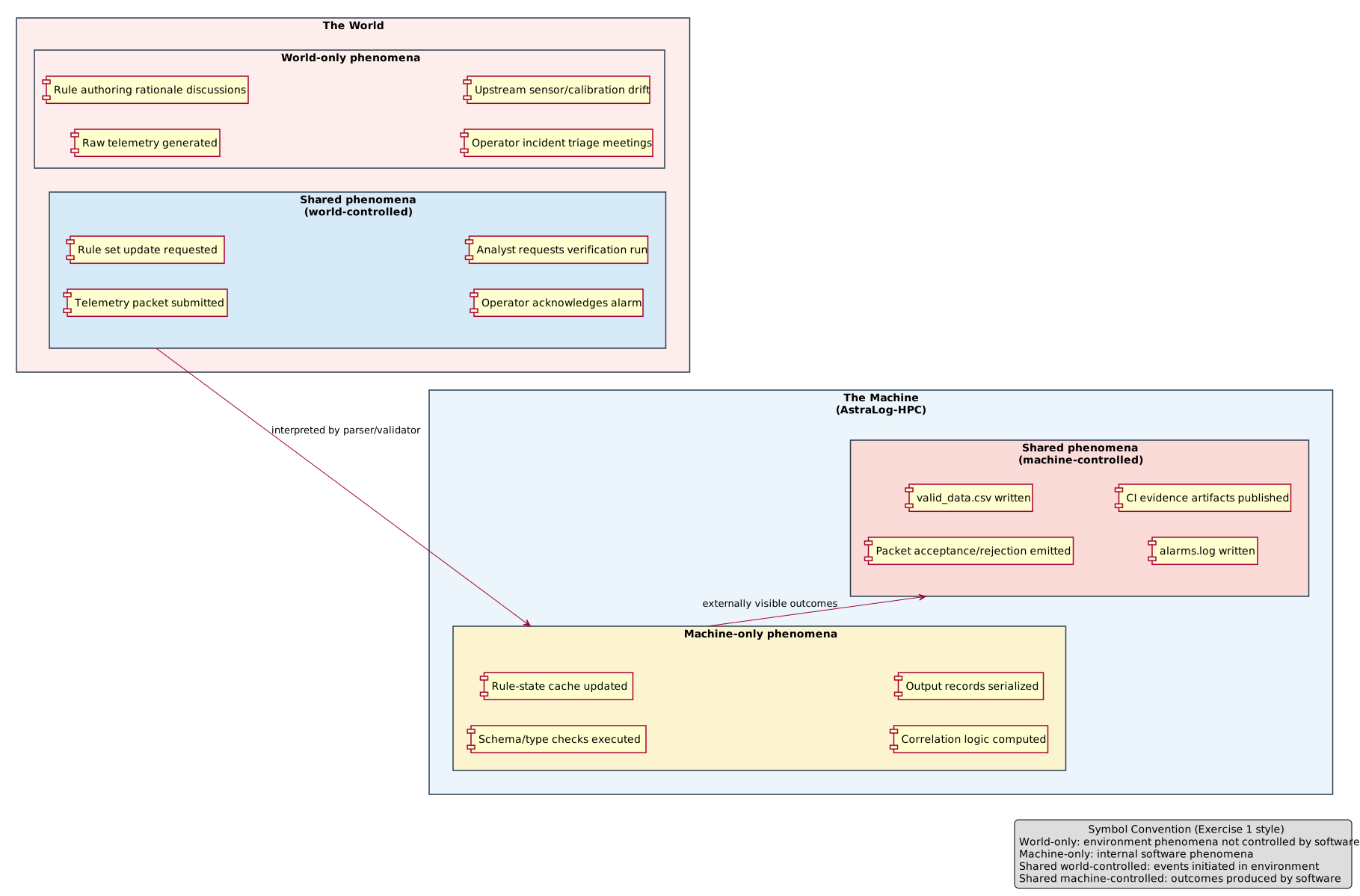
phase1/uml — world ↔ machine & shared phenomena
L1 · Intro
Lecture 202.QualitiesAndHPCSoftware.pdf
HPC Qualities & SE Methods
- Seven HPC qualities drive every design decision.
- Verify desired properties when full proof is impractical.
- Performance must not erode maintainability or portability.
- Reliability = defensive programming + testing + observability.
AstraLog → each quality maps to explicit NFRs; malformed input is rejected
safely (NFR-05/11) and execution stays deterministic for verification (NFR-01).
docs ✅impl ✅perf benchmark ✅CI ✅
7 HPC qualities → AstraLog NFRs
| Correctness | NFR-01 rule semantics under deterministic inputs |
| Performance | NFR-03 stable throughput on target CSV workloads |
| Reliability | NFR-05 / NFR-11 defensive boundary validation |
| Scalability | NFR-04 documented distribution strategy (≥3) |
| Portability | NFR-13 / NFR-17 local · VM · SLURM · same .sif |
| Maintainability | NFR-07 / NFR-12 modular, evolvable components |
| Operability | NFR-15 observable logs & deterministic outputs |
L2 · Qualities
Lecture 303.RE.pdf
Requirement Engineering
- World vs machine; shared phenomena at the boundary.
- Separate G goals · DA domain assumptions · R requirements.
- Requirement quality: clear, complete, consistent, verifiable.
- Use cases capture actor ↔ machine interactions.
AstraLog → FR-01…19, NFR-01…17, DA, MR1–MR3 all implemented. Mission config
config/alpha_mission/ (20 rules, all 4 types) from SimoneReale/astralog-control. Output formats match PDF §3.docs ✅impl ✅tests ✅format ✅
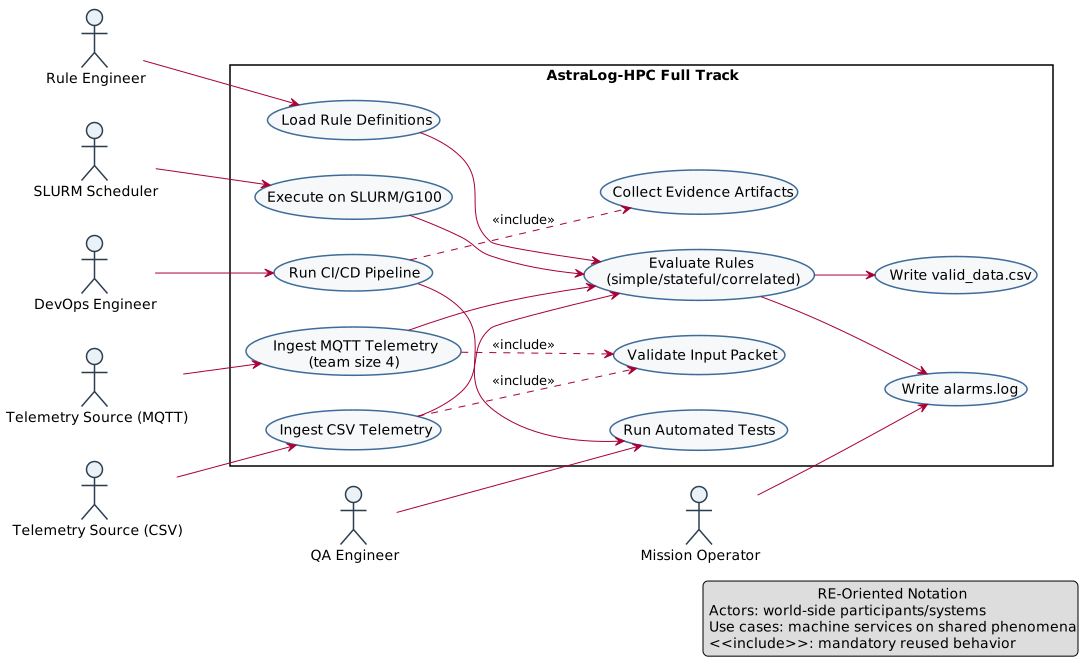
phase1/uml — use-case diagram
L3 · RE
Exercise 11_exercise_lecture_sol.pdf
RE process — applied to AstraLog
- Exercise pattern: build a world-machine + use-case model of a system.
- World phenomena: real sensor values on the spacecraft bus.
- Shared phenomena: telemetry packet (CSV row / MQTT message).
- Use cases: Process batch · Evaluate rules · Raise alarm · Emit valid record.
Implemented → the model is realised by the chain
ingestion → rule_engine → anomaly_detector → output_writer.solution ✅docs ✅MQTT C++ ✅
AstraLog world-machine — exercise solution
Ex1 · RE process
Lecture 404.Design.pdf
Software Design & Architecture
- Multi-view design: C&C, module, deployment.
- Architecture decisions precede and constrain code.
- Ariane-5: reuse without re-validation is a design failure.
AstraLog → four-component C&C view (Ingestion → Rule → Classifier →
Output) plus a
RuntimeExecutionAdapter isolating local vs SLURM.docs ✅adapter unimpltests ✅UI ✅
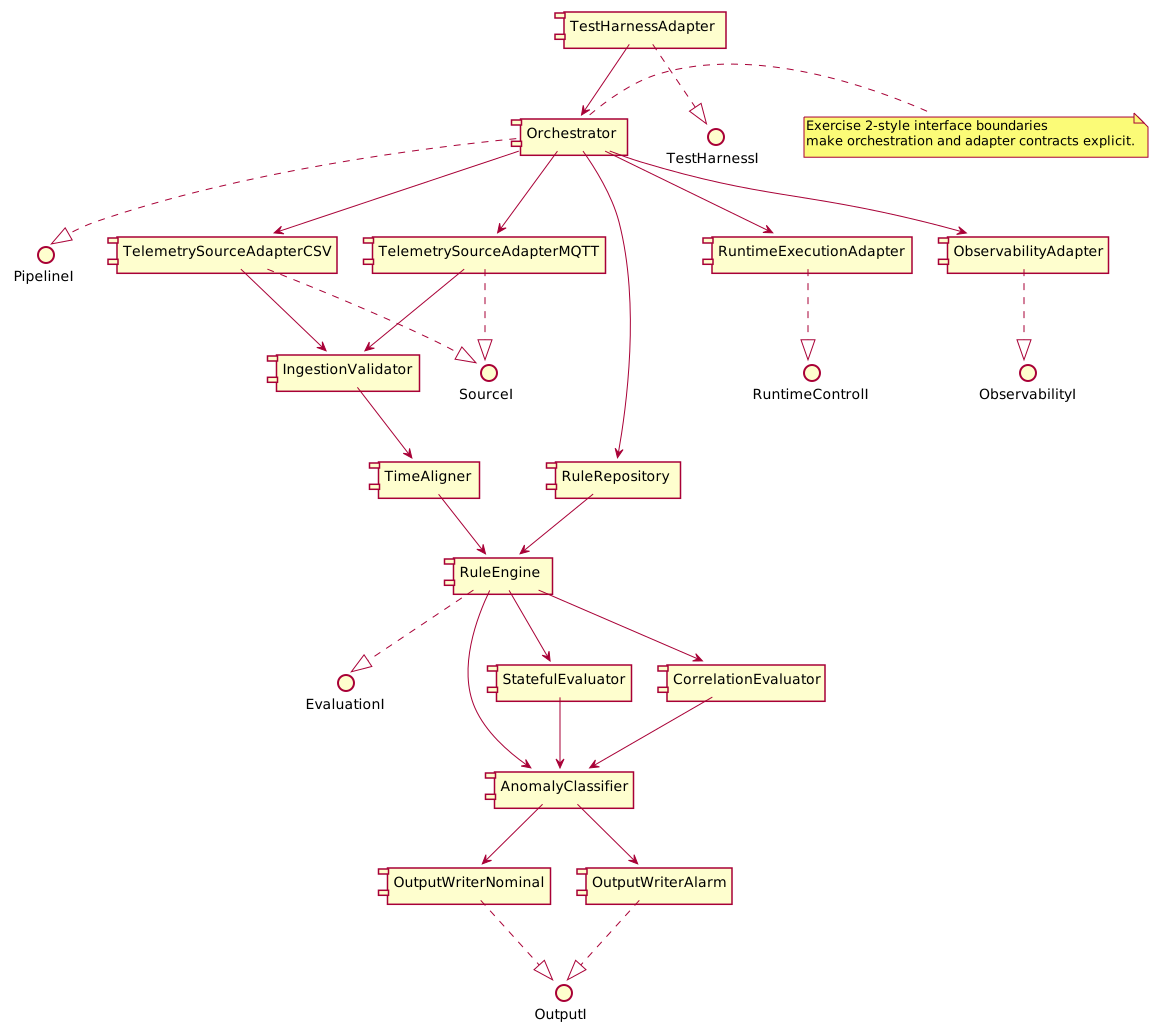
phase2/uml — full-track components & interfaces
L4 · Design
Exercise 22_exercise_lecture_sol.pdf
Architecture with explicit interfaces
- Exercise pattern: components with provided/required interfaces + adapter.
- AstraLog interfaces: Ingestion, RuleEngine, Classifier, OutputWriter.
- Adapter boundary:
RuntimeExecutionAdapterhides the runtime.
Implemented → headers in
src/cpp/include/astralog/*.hpp realise
each interface; the full-track component diagram shows provided/required ports.solution ✅adapter unimpldocs ✅
src/cpp/include/astralog/*.hpp — component interfaces
// C&C view realised as four C++ components
class IngestionValidator {         // FR-02, NFR-05
    std::optional<Record>
        validate(const TelemetrySample&) const;
};
class RuleEngine {                 // FR-04/06
    std::vector<Violation>
        evaluate(const Record&) const;
};
class AnomalyClassifier {          // FR-07/08
    AnomalyEvent classify(
        const Record&,
        const std::vector<Violation>&) const;
};
// OutputWriter → valid_data.csv · alarms.log
//              · pipeline_summary.json
Ex2 · Architecture
Lecture 505.DesignPartiII.pdf
Design Principles (Part II)
- Nine principles: low coupling, high cohesion, information hiding…
- …separation of concerns, abstraction, anticipation of change.
- Modular decomposition keeps components independently testable.
AstraLog → header/impl separation + single-responsibility components give
low coupling (NFR-07) and evolvability for new rule types & sources (NFR-12).
docs ✅impl ✅tests ✅
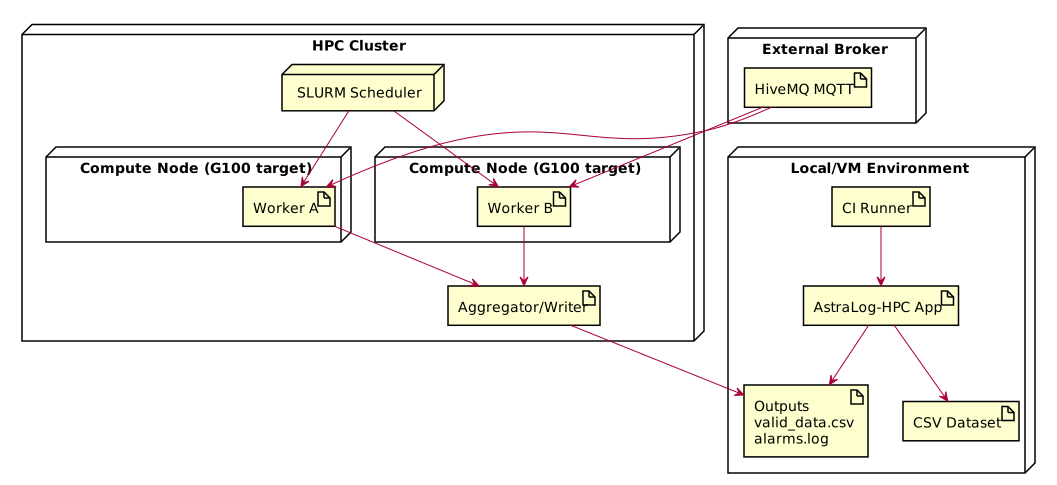
phase1/uml — module decomposition view
L5 · Principles
Lecture 606.DesignPartIII.pdf
Architectural Styles
- Dataflow, pipeline, event-driven, pub/sub (MOM), shared-data.
- Batch vs stream processing trade-offs.
- Style choice must follow the requirements, not fashion.
AstraLog → pipe-and-filter for the CSV batch path; event-driven pub/sub for MQTT, with the C++
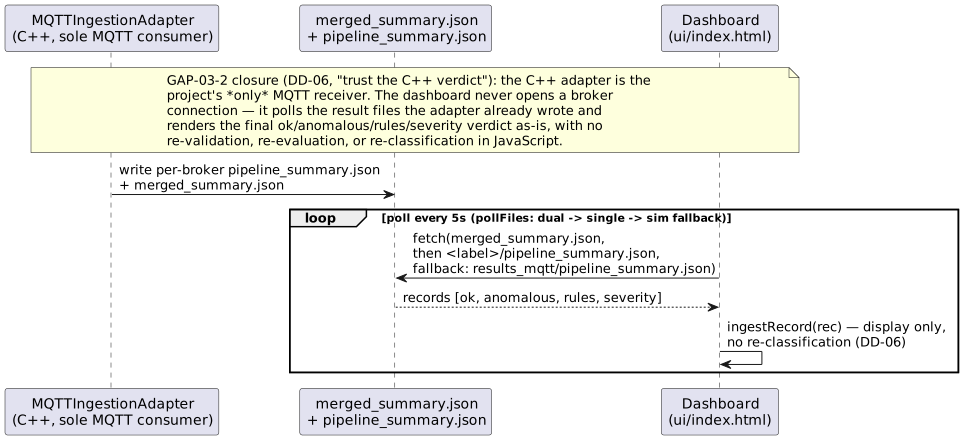
MQTTIngestionAdapter as the project's sole broker client (parallelized across both canonical brokers via run_multi_broker_ingestion, GAP-03-2/DD-06) — the JS dashboard never touches the broker, it reads the adapter's output files. Both paths feed the same pipeline via the abstract MQTTTransport interface.docs ✅impl ✅C++ MQTT ✅UI ✅
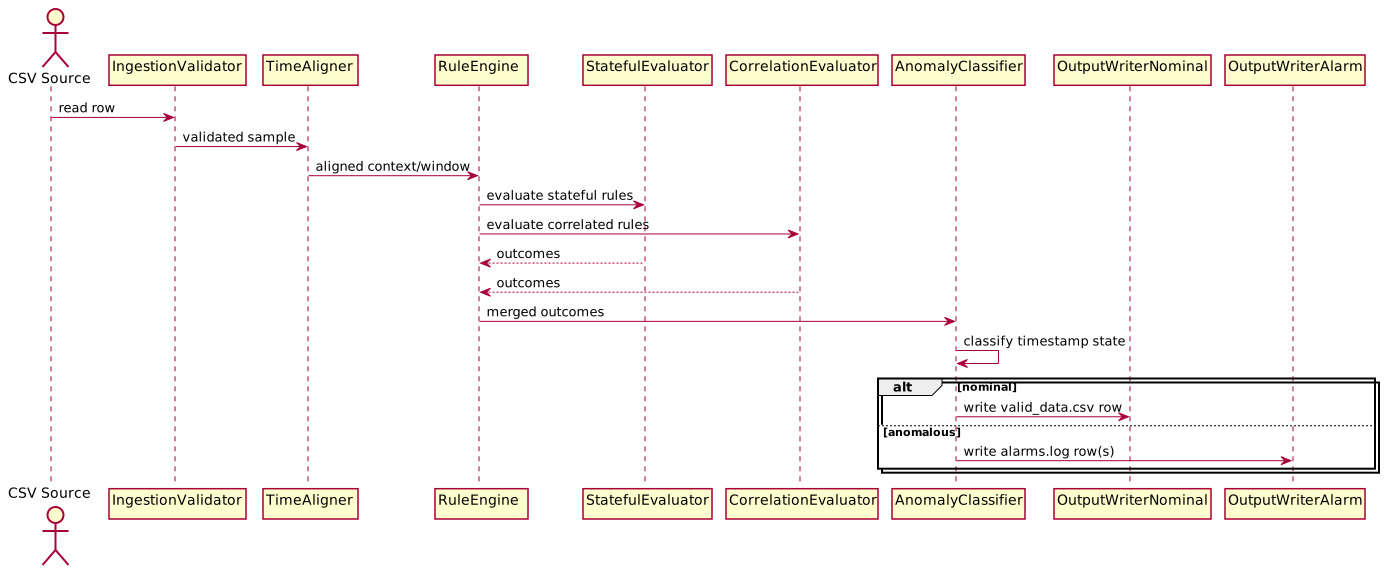
phase2/uml — CSV pipeline (batch dataflow)
L6 · Styles
Exercise 33_exercise_lecture_no_sol.pdf
Style choice + justification
- Exercise pattern: pick a style and justify it against requirements.
- CSV path → pipeline: linear filters, deterministic, easy to test.
- MQTT path → pub/sub: decoupled producer/consumer over the broker.
Implemented → C++ pipeline for batch; the C++
MQTTIngestionAdapter is the
sole wss://broker:8884 (MQTT v5) consumer, run in parallel across both canonical
brokers — the static dashboard never opens a broker connection, it polls the adapter's result
files instead (GAP-03-2/DD-06, "trust the C++ verdict").solution ✅MQTT adapter ✅UI file-reader ✅
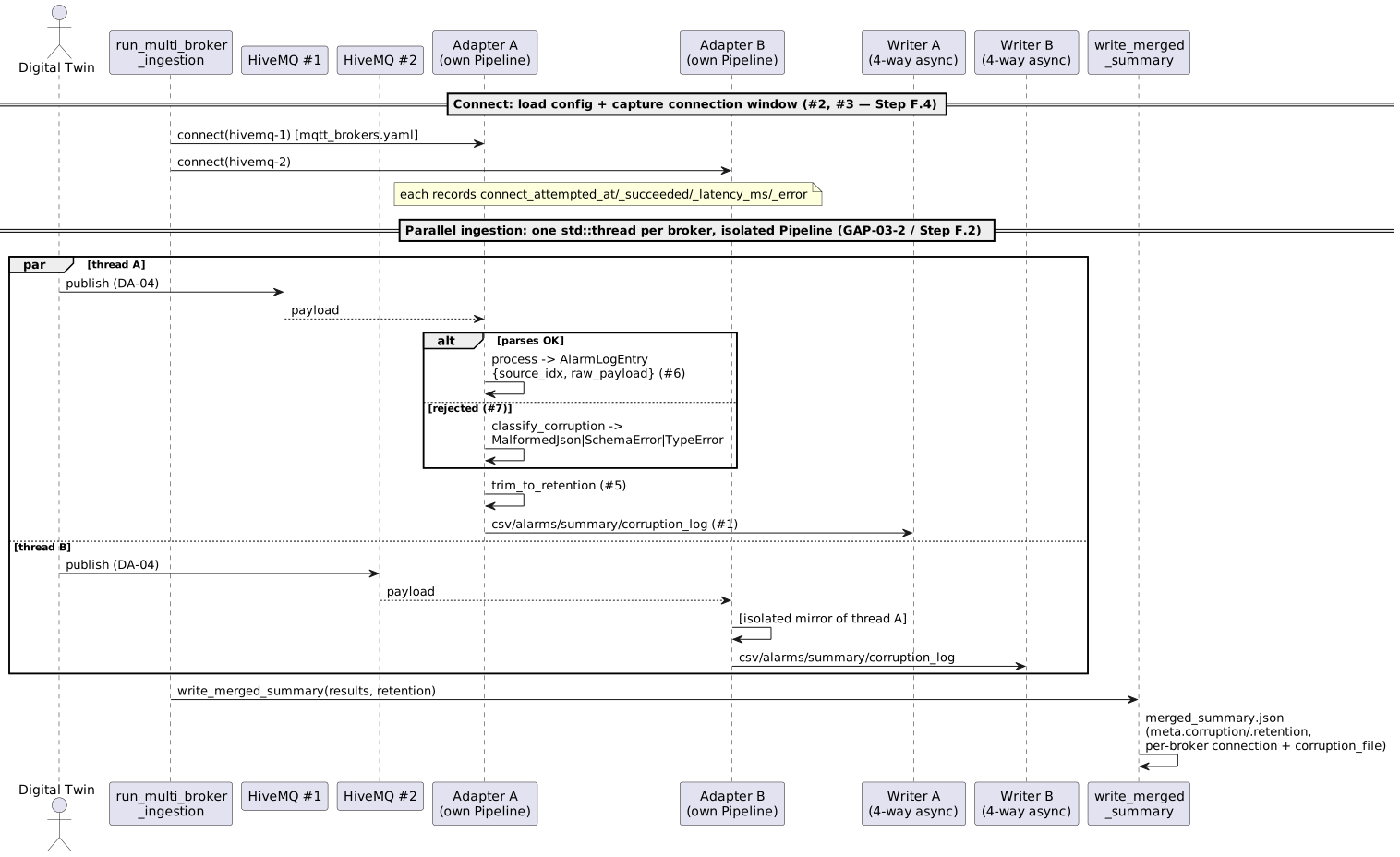
phase2/uml — parallel dual-broker MQTT ingestion (sole consumer)
Ex3 · Style pick
Lecture 707.VVPartI.pdf
V&V I — Arch Verification & Petri Net
- QA policy; the V model from unit up to acceptance.
- Architectural verification checklist; concurrent-resource review.
- Petri nets for formal concurrency verification (deadlock, liveness, boundedness).
AstraLog → phase2 Step 16b models
run_multi_broker_ingestion
as a P/T net: T1 ‖ T2 concurrent threads; T3 join guard [P3 ∧ P4] enforces ordering before
write_merged_summary(). Verified: deadlock-free, safe (1-bounded),
live. Maps 1-to-1 to the std::thread + join() implementation.docs ✅Petri net ✅CI ✅
P/T net — dual-broker pipeline
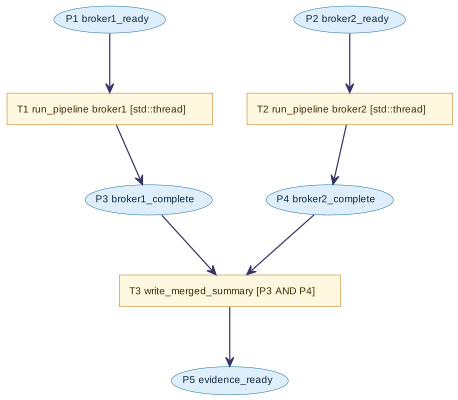
Blue ovals = places · Yellow rect = transitions · ● = initial token
T3 fires only when both P3 and P4 hold a token (join synchronisation)
T3 fires only when both P3 and P4 hold a token (join synchronisation)
L7 · V&V I
Lecture 808.VVPartII.pdf
V&V II — Static & Dynamic Analysis
- Static vs dynamic analysis; black-box vs white-box tests.
- Fuzz / boundary testing surfaces undefined behaviour.
- Negative tests are as important as positive ones.
AstraLog →
cppcheck static-analysis CI stage + boundary/negative
fixtures; the pipeline must never crash on malformed input (NFR-05/11). v0.8.1:
every rejected MQTT packet is now triaged by classify_corruption()
(syntax → schema → type gates) into MalformedJson/SchemaError/
TypeError and logged to corruption_log.json for operator
diagnosis (GAP-08-1 partially closed).docs ✅impl ✅fuzz test ✅coverage CI ✅
CTest v1.0.1 — 9 / 9 (8 fast + 1 characterization)
| 1/9 smoke_test ✅ 0.12s | End-to-end pipeline: CSV in → validated records → anomaly JSON out |
| 2/9 fr_matrix_test ✅ 0.04s | FR-02/04/07 assertions on deterministic boundary fixtures |
| 3/9 config_loader_test ✅ 0.09s | YAML mission-config loading + all 4 rule-type deserialization |
| 4/9 rule_engine_full_test ✅ 0.18s | All 4 rule types (Simple/Stateful/Delta/Compound) against live config |
| 5/9 mqtt_test ✅ 0.31s | MockMQTTTransport: connect/disconnect success & failure paths (19 sub-tests) |
| 6/9 metamorphic_test ✅ 0.07s | MR1 alarm uniqueness · MR2 sensor independence · MR3 stateful reset |
| 7/9 fuzz_test ✅ 0.89s | 1100 random inputs, seed 0xDEADBEEF; invariants I1–I4 never violated |
| 8/9 output_writer_int… ✅ 0.21s | PDF §3 format, all 3 CorruptionKind events, empty-output edge cases |
| 9/9 slurm_char_test ★ characterization | 2000 G100 SLURM records replayed (job 20768390); golden-file match: 468 anomalies, 1415 nominal (FR-01/04/05/06/08, FR-14) |
L8 · V&V II
Lecture 909.VVPartIII.pdf
V&V III — Test Gen & Metamorphic
- Metamorphic testing + metamorphic relations (MRs) as oracles.
- Concurrent testing; xUnit-style frameworks.
- Deterministic logic makes MR oracles tractable.
AstraLog → All 4 rule types implemented + tested. Dedicated
metamorphic_test.cpp (v0.9.4, closes GAP-09-1) implements MR1 (alarm uniqueness), MR2 (sensor independence), MR3 (stateful persistence via consecutive-violation counting) using Pipeline({rules}) + hand-built RuleConfig fixtures.docs ✅impl ✅metamorphic_test.cpp ✅all 4 rule types ✅
src/cpp/tests/metamorphic_test.cpp · MR3 — stateful persistence
// MR3: Stateful rule fires on exactly the N-th
// consecutive violation (consec_violations=3),
// not before — and resets on a nominal sample.
Pipeline p({stateful_rule});  // threshold = 3

assert(!p.process(spike).has_value()); // #1 ✗
assert(!p.process(spike).has_value()); // #2 ✗
assert( p.process(spike).has_value()); // #3 ✓
assert(!p.process(nominal).has_value());// reset
L9 · V&V III
Exercise 44_exercise_lecture_no_sol.pdf
Availability analysis — AstraLog
- Exercise pattern: series $A=\prod A_i$ · replication $A=1-(1-A)^n$.
- Identify the weakest links and replicate them.
- Target: meet NFR-16 availability ≥ 0.98 — requires replicating Ingestion + Classifier.
- Architectural strategies exist to raise availability beyond paper analysis.
AstraLog → dual-broker MQTT already realises ingestion replication.
Checkpoint/restart and active-passive failover are the natural next steps for G100.
solution ✅docs ✅replication on paper
Series → replication
Ingestion (weakest)0.97
Rule engine · Classifier · Output0.99 · 0.98 · 0.99
Series ∏0.9315
k=2 Ingestion + Classifier≈ 0.988 ✓
Architectural strategies to go further
| Component replication | k=2 on weakest stages — dual-broker MQTT already does this at ingestion; maps to SLURM multi-task (T6) |
| Checkpoint / restart | Write checkpoint.json every N records; SLURM resubmit resumes from last checkpoint — eliminates full-job loss |
| Active-passive failover | Watchdog monitors heartbeat file; secondary pipeline takes over if primary silent > threshold |
| Full pipeline × voter | Two full instances run in parallel; write_merged_summary() acts as voter — total $A≈0.995$ |
Ex4 · Availability
Lecture 1010.CM.pdf
Configuration Management
- Decentralized Git / GitHub flow; branch & tag discipline.
- Semantic versioning vMAJOR.MINOR.PATCH.
- Commit conventions + a maintained CHANGELOG.
AstraLog → phase1 §3.7 CM policy; tags v0.1.0 → v0.6.0; a
CLAUDE.md change-propagation matrix + file-registry.md keep artifacts in sync.docs ✅impl ✅CI ✅
Release timeline (semantic versioning)
v0.1.0 Phase 1 baseline — requirements, architecture, UML
v0.3.0 CI pipeline + AI skill system + priority field
v0.4.0–v0.5.x Lec 10–13 + Ex05 + Apptainer container + UI dashboard
v0.6.0 All-lecture validation pass + Reveal.js presentation
v0.7.0 All 4 rule types + MQTT adapter + config loader + parallel eval
v0.8.0–v0.8.4 Dual-broker MQTT + real
PahoTransport live capture (720 msgs, 229 anomalies)v0.9.0 First SLURM job on CINECA G100 — NFR-17 mobility confirmed end-to-end
v0.9.1–v0.9.2 GAP-14-1 fix (
anomalies=0 root cause) + G100 re-run (job 20768390, 468/1883)v0.9.3–v0.9.4
kPipelineVersion constant + 6 V&V gaps closed (8/8 CTest, lcov, fuzz, metamorphic, perf, signing)v1.0.0 Petri net V&V · Engineering Challenges slide · doc polish · all GAPs closed ✅
L10 · CM
Lecture 1111.CI_CD.pdf
CI / CD Pipelines
- DevOps loop: Plan→Create→Verify→Package→Release→Configure→Monitor.
- GitHub Actions YAML; pinned action versions.
- Continuous delivery (not deployment) — G100 has no runner.
AstraLog →
ci-baseline.yml builds, lints, tests, runs the batch
pipeline, validates JSON, and uploads evidence; slurm-deploy.yml ships the signed .sif.docs ✅impl ✅tests ✅5 CI stages ✅
.github/workflows/ci-baseline.yml — stages
- name: Configure C++   # cmake -S src/cpp -B build
- name: Build C++       # cmake --build build
- name: Static analysis (cppcheck)
- name: Run C++ tests   # ctest --output-on-failure
- name: Run C++ batch pipeline  # --batch 200 --out results
- name: Validate pipeline_summary.json schema
- name: Upload CI evidence artifacts   # ci-evidence
L11 · CI/CD
Lecture 1212.Schedulers.pdf
Schedulers — SLURM
- Job · Job-step · Node · Partition · Account / Association.
- Daemons:
slurmctld·slurmd·slurmdbd. - Commands:
sbatch·srun·squeue; FIFO → priority → backfill. - Parallelism:
RuleEngine --parallel·run_multi_broker_ingestion· output fan-out. --parallel:std::asyncper independent rule (Simple + StepDiff, 13/20) — scales with--cpus-per-task.- Dual-broker: one
std::threadper broker (fixed 2) · output fan-out: 4 concurrentstd::asyncwriters.
AstraLog → one Job + one Job-step on Galileo100; the job script follows the
lecture's batch-script pattern exactly.
docs ✅impl ✅T5–T7 deferred
scripts/slurm/astralog_g100.sbatch
#SBATCH --job-name=astralog
#SBATCH --account=<budget>      # G100 association
#SBATCH --partition=g100_usr_prod
#SBATCH --nodes=1 --ntasks-per-node=1
#SBATCH --cpus-per-task=4 --mem=8G --time=00:30:00

module load apptainer
srun apptainer exec --bind $HOME/astralog:/data \
     astralog.sif astralog_demo --batch 200 --out /data/results
L12 · Schedulers
Lecture 1313.Containers.pdf
Containers — Docker & Apptainer
- Multiplicity problem; containers vs VMs (host kernel, MB, instant).
- Docker for local · Apptainer/Singularity for HPC.
- SIF immutability + signature; integration over isolation; same UID/GID.
AstraLog → one
astralog.def builds the image from source; the same
signed .sif runs in CI and on G100 (NFR-16/17).docs ✅impl ✅signing CI ✅ (GAP-13-1)
singularity/astralog.def
Bootstrap: docker
From: ubuntu:22.04

%post
    apt-get install -y --no-install-recommends cmake g++ make
    cmake -S /opt/astralog/src/cpp -B /opt/astralog/build
    cmake --build /opt/astralog/build -j 2

%runscript
    exec /opt/astralog/build/astralog_demo "$@"
L13 · Containers
Exercise 55_exercise_lecture_updated_no_sol.pdf
Integration testing — AstraLog
- Exercise pattern: choose + justify a strategy and a concrete plan.
- Choice: thread-based incremental along the dataflow chain.
- No stubs/drivers — deterministic fixtures suffice.
Implemented → T1/T2/T4 covered by
fr_matrix_test.cpp +
smoke_test.cpp; T3 now has a dedicated
output_writer_integration_test.cpp (v0.9.4, closes GAP-Ex5-1) with 5 named
test cases covering the PDF §3 format spec, all 3 CorruptionKind events, and
empty-output edge cases; T5 ran on G100 (job 20768390); T6/T7 remain stretch
goals.solution ✅T3 done ✅T5–T7 G100
Integration threads (T1 → T7)
| Thread | Boundary | Status |
|---|---|---|
| T1 | Ingestion + Rule | ✅ done |
| T2 | Rule + Classifier | ✅ done |
| T3 | Classifier + Output | ✅ done (v0.9.4) |
| T4 | End-to-end pipeline | ✅ done |
| T-MQTT | MQTT ingestion → pipeline | ✅ done |
| T5 | SLURM + config-driven pipeline | ✅ done (v1.0.1) |
| T6–T7 | SLURM multi-task/aggregate | ⚠️ stretch |
CTest v1.0.1 — 9/9 wired
smoke · fr_matrix · config_loader · rule_engine_full
mqtt · metamorphic · fuzz (1100 iter) · output_writer_integration
+ slurm_characterization_test (G100 job 20768390 golden file)
validated=1883 anomalies=468 · rejected=117 · [SKIP] in CI
smoke · fr_matrix · config_loader · rule_engine_full
mqtt · metamorphic · fuzz (1100 iter) · output_writer_integration
+ slurm_characterization_test (G100 job 20768390 golden file)
validated=1883 anomalies=468 · rejected=117 · [SKIP] in CI
Ex5 · Integration
Engineering Challenges
Key Difficulties & How We Tackled Them
- C++ vs Python — preferred Python but chose C++ for deterministic HPC performance, native POSIX threading, and Apptainer portability. Python retained for analysis notebook only.
- AI skill architecture — structured a layered system: global SE4HPC course skill + project-local domain skills (
docs/skills/) loaded per context (SLURM, MQTT, V&V) to keep sessions focused. - Lecture ↔ requirement traceability — spiral review: every FR/NFR traced to a lecture slide; every lecture deliverable mapped to a concrete artifact via
docs/se4hpc-checklist.md+ GAP backlog. - Doc / code sync across 14 releases — change-propagation matrix in
CLAUDE.md; mandatory pre-commit bookkeeping checklist (07-log, file-registry, CHANGELOG, version cells) enforced before every commit gate. - Static dashboard without HTTP server — C++ adapter ran once against live HiveMQ (~60 s, 720 msgs, 229 anomalies); frozen JSON published to gh-pages and replayed in a loop. Production path:
.sifon server + nginx for live feed. - Three-environment DevOps — local MK container → GitHub Actions → CINECA G100. Four
scripts/slurm/01–04automate the fetch/stage/submit/retrieve cycle. Same CI-built.siftransferred without on-cluster rebuild (NFR-17 mobility-of-compute).
Engineering decisions summary
| Challenge | Resolution |
|---|---|
| Language choice | C++ pipeline / Python analysis |
| AI context management | Layered skill architecture |
| Lecture coverage | Bidirectional traceability + GAP table |
| Version drift | Propagation matrix + commit gate |
| Static demo | One-time live capture → frozen replay |
| Multi-env DevOps | 4-script automation + NFR-17 .sif |
AstraLog-HPC · Engineering Challenges
Full Track · Single Student · All gaps closed
13 lectures + 5 exercises → docs · code · tests · CI · G100 · UI
Every lecture is traced through Phase 1/2 requirements & design, the C++ implementation,
the test suite, the CI/CD pipeline, the dashboard, and this deck — recorded in
docs/se4hpc-checklist.md. 9/9 CTest tests wired (8 fast pass always; 9th characterization test replays 2000 G100 records with golden file, [SKIP] in CI). G100 evidence: job
20768390 · samples=2000 · anomalies=468. Petri net verified concurrency.
Two-tier Apptainer signing in CI.
v1.0.1
Live deck + dashboard + G100 evidence
9/9 CTest · slurm_characterization_test ✓
Mission close: 2026-06-14
AstraLog-HPC v1.0.1 · thank you